


How to Tell If Clothing Is Dropshipped Before You Buy

Last Updated: October 28, 2026
Quick Summary
To tell if clothing is dropshipped, compare the same item across multiple storefronts, read the shipping and fulfillment language, and reverse-search the product photos. Any one clue is weak, but three together is a pattern. Knowing how to tell if clothing is dropshipped lets you judge whether the seller adds value or just marks up a catalog item.
Dropshipped clothing is apparel sold by a store that never holds the item in stock.
The single most reliable test is comparing the same item across multiple storefronts.
On TinEye, sort reverse image results by oldest to find the supplier catalog.
Two strong signals, or one strong plus two medium, is enough to treat a store as a likely dropshipper.
If a store fails three or more pre-purchase checks, walk away.
Table of Contents
What Dropshipped Clothing Actually Means
Dropshipped clothing is apparel sold by a store that never holds the item in stock.
That definition matters because it is not automatically a scam.
What it does tell you: nobody in the chain has touched that shirt before it reaches you.
Below, we'll show you how to tell if clothing is dropshipped, in five steps, with the specific clues that hold up.
How to Check If a Product Is Dropshipped in Five Steps
The fastest way to check if a product is dropshipped is to compare the same item across multiple stores, read the shipping language, and reverse-search the photos. Any one clue is weak. Three together is a pattern.
Work through these in order. Each step takes a minute or two.
Step 1: Scan the Product Listing for Supplier Language
Open the product description and read it out loud. Dropshipped listings often carry language the seller did not write.
Look for:
Vague claims with no specifics ("premium quality fabric")
Sizing charts in centimetres only, with no brand sizing
Descriptions that describe a category, not this exact shirt
A real small brand may provide specific product details. A dropshipper describes a product it has never seen.
Step 2: Compare the Same Item Across Multiple Storefronts
This is the single most reliable test. Take the product photo and search for it on other marketplaces.
If the identical design appears on five different stores under five different names, you have found a catalog item. Nobody in that chain designed it; the stores compete on ads, not craft.
Duplicate listings are not proof of fraud. They are proof that the seller is not the source.
Step 3: Read the Shipping and Fulfillment Details
Shipping language gives dropshippers away faster than anything else on the page.
Watch for delivery estimates in weeks rather than days, "ships from our partner warehouse," or "processing time: 5-10 business days." Check whether tracking arrives late or shows an origin country the store never mentioned.
A store that routes orders to a supplier may not tell you where your package starts.
Use Reverse Image Search for Clothing Listings
Reverse image search is the closest thing to a paper trail in apparel. A dropshipped shirt almost always starts as a supplier photo that exists somewhere older and cheaper than the store you are looking at. The trick is running the search to surface the source rather than a hundred resellers.
A Practical Step-by-Step Method
Capture the cleanest image on the listing. Save the main product photo, not a screenshot with the store's logo or a lifestyle shot with a model. Flat-lay or ghost-mannequin images trace best because they are the supplier's original asset.
Crop to the garment. If the photo includes a model's face or a styled background, crop to the shirt itself. Reverse-image engines match on the dominant subject, and a face or room pulls unrelated results.
Run it through more than one engine. Google Lens is the common starting point, but TinEye is better at finding older and modified copies because it indexes by image fingerprint rather than page context. Run the same crop through both.
Sort by oldest, not by relevance. On TinEye, sort results by "oldest." On Google Lens, scan result dates and page titles. The earliest appearance is usually the supplier catalog or original marketplace listing.
Open the earliest result and read its title and price. If the oldest listing is on a wholesale or marketplace site at a fraction of the store's price, you have found the source. If it is the brand's own site or a dated social post crediting an artist, that is a point in the seller's favour.
Repeat with the description text. Copy a distinctive sentence from the product description, put it in quotes, and search. Supplier descriptions get copied verbatim across stores, so an exact-phrase search often surfaces the same listing under different store names.

What the Results Actually Tell You
The same photo appears on many stores, with the oldest on a marketplace or wholesale site. Catalog item. The seller is reselling a supplier product.
The photo appears on a supplier catalog site with a minimum order quantity. You found the source. The store is a middleman buying single units.
The photo appears only on the brand's own site and socials, with dated posts. A better sign, not proof on its own, but a point in the seller's favour.
Watch Out Original art gets stolen, and reverse image search cannot tell you who copied whom. A design appearing elsewhere does not automatically mean the store you are looking at is the copycat. Check the dates, the artist credits, and whether the other listing looks like a wholesale catalog or a fellow small brand.
Clothing-Specific Checks Beyond the Photo
Photos are only one asset that gets copied. For apparel, run the same trace on three more things:
The size chart. Supplier charts are often centimetres-only, reuse the same generic table across dozens of stores, and list measurements that do not match the brand's stated fit. Search a distinctive row of numbers in quotes.
The model images. The same model appearing across unrelated stores is a strong supplier signal. Crop to the model's face and reverse-search it.
The fabric and care text. Phrases like "polyester blend, machine wash cold" are generic, but longer supplier descriptions often contain odd phrasing or translation artifacts that survive copy-paste. Search a full sentence in quotes.
A single match is a clue. A photo, size chart, and description sentence all tracing to the same supplier catalog is a pattern you can act on.
Dropshipping Clothing Store Red Flags to Watch For
Red flags cluster in two places: the storefront and the product page. Check both before you enter card details, but treat every item as a clue, not a verdict. Plenty of legitimate small brands have a thin about page or a countdown timer, and plenty of dropshippers have polished storefronts. Combine several weak signals into a confident judgment rather than disqualifying a store on one cosmetic detail.
ONHOW Studio
Warning Signs in the Storefront Itself
A huge catalog across unrelated categories, from tees to phone cases to kitchen gadgets
Every product photo styled identically, with no lifestyle shots or behind-the-scenes content
No about page, or an about page with no names, no photos, and no story
None of these proves a scam. Together, they describe a store with no skin in the game.
Warning Signs in the Product Photos and Descriptions
Image quality is the tell most buyers miss. Dropshipped listings often use supplier photos: flat, brightly lit, identical across stores. Look for mockups where the design sits slightly wrong on the shirt, or the same model appearing in twenty listings.
Also check the description for missing detail: no fabric weight, no print method, no care instructions. A seller who has held the shirt knows these things.
Apparel-Specific Signals Competitors Miss
Clothing has its own tells that generic dropshipping checklists skip. These rank highest:
Size charts in centimetres only, with no brand sizing. A seller who has handled the garment can tell you how it fits relative to a known brand. A dropshipper copies the supplier table.
No fabric composition or garment weight. "Premium cotton" with no grams-per-square-metre figure or blend percentage is written from a catalog, not a sample.
Inconsistent stock across sizes and colours. Supplier inventory fluctuates, so a dropshipper's size run sells out in odd patterns while the store claims everything is in stock.
Key Takeaway Rank the signals by reliability. The strongest are duplicate listings traced to a supplier, a return address at a third-party fulfilment centre, and tracking that originates somewhere the store never disclosed. Medium signals include centimetre-only size charts, missing fabric specs, and inconsistent stock. Weak signals include countdown timers, thin about pages, and new social accounts. Two strong signals, or one strong plus two medium, is enough to treat a store as a likely dropshipper. A single weak signal is not.
Consumer Checks Before You Buy Clothing
Red flags tell you what to avoid. These checks tell you what to confirm before checkout:
Find the return address and confirm who pays return postage
Read the refund terms in full, including restocking fees and the return window
Confirm the delivery estimate and where tracking will originate
If a store fails three or more of these, walk away. Plenty of sellers will pass.
Dropshipped vs Print-on-Demand Clothing: Why the Difference Matters
Dropshipped and print-on-demand clothing both ship from a third party, but they are not the same thing. Print-on-demand means a design is printed when you order it, usually by a printing partner (Print on Demand: What It Is & How To Start (2026)).
The difference shows up in three places:
Factor | Dropshipped | Print-on-Demand |
Who made the design | Often unknown | Usually the seller |
Print quality control | None | Varies by print partner |
Shipping origin | Supplier warehouse | Print facility |
Returns handling | Often slow | Usually clearer |
Why it matters: print-on-demand sellers usually created the artwork; dropshippers usually did not. If supporting original work is the point, that distinction decides where your money goes.
Whichever route your tee comes from, the care rules are the same. Our guide to how to care for screen printed tees covers washing and drying without cracking the print.
Consumer Checks Before You Buy Any Graphic Tee
Before checkout, run these checks, five minutes that save a lot of returns.
Reverse-search the main product photo
Compare the design on at least two other stores
Read the full shipping estimate, not just the headline
If a store fails three or more of these, walk away. Plenty of sellers will pass.
Once you have vetted a tee, styling is the next problem. Our piece on how to style bold graphic t-shirts covers wearing loud prints without looking like you raided a costume box.
Shop Small, Original Art Instead of Guessing
Here is the honest version. Most of these checks exist because the market is full of stores that add nothing between you and a supplier catalog.
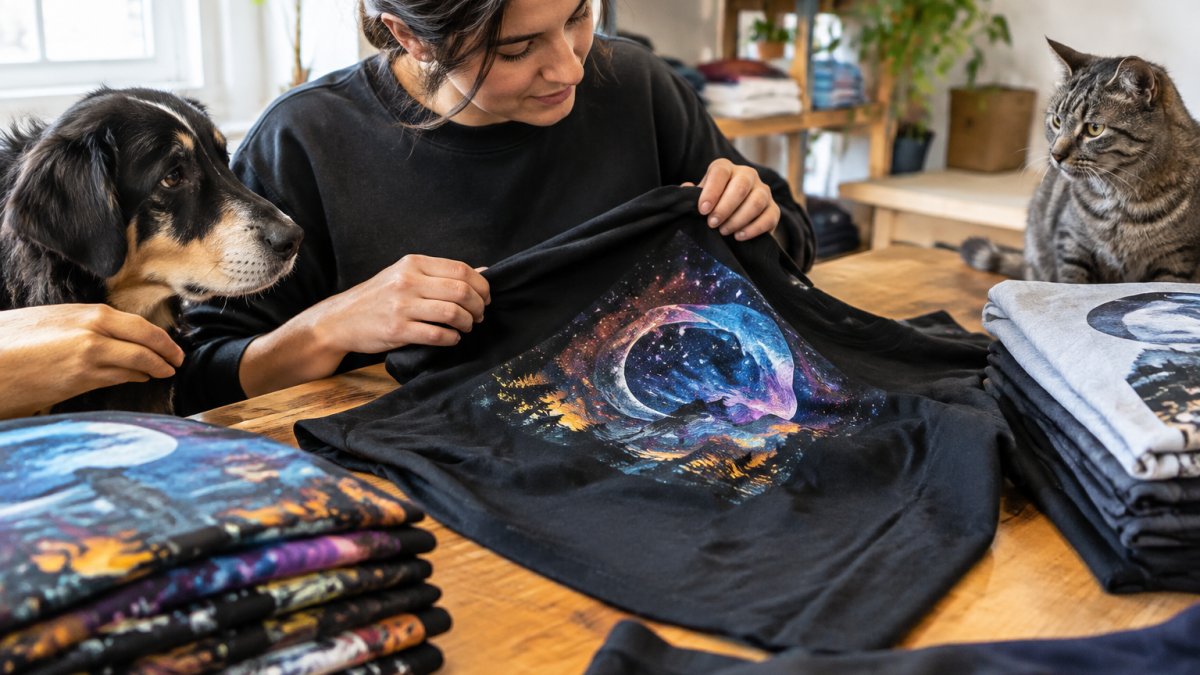
Every design comes from a husband-and-wife team with 30+ years of creative mastery, inspired by our cat, Diablo, and our dog, Athena.
If you would rather skip the detective work, browse indie surrealist clothing that's actually good and see the difference for yourself. Want something custom? Reach out to us and tell us what you have in mind.
Frequently Asked Questions
Is dropshipping clothing illegal?
Dropshipping is a fulfillment arrangement where a seller takes your order and a third-party supplier ships it. The arrangement alone does not establish whether a store is trustworthy. Check the seller's shipping and return information before buying.
Are long shipping times a sign that clothing is dropshipped?
Long shipping times alone do not establish whether clothing is dropshipped. Check the seller's shipping information and look for other clues, such as identical product photos on other sites.
How do I use reverse image search for clothing before buying?
Save the product photo, then use an image search tool. If the same shirt appears on other storefronts with different brand names, that may be a clue to investigate further. An image search result alone does not establish who created the design.
Does dropshipping always mean clothing is low quality?
Dropshipping alone does not establish a shirt's quality. Check the product information and the seller's policies before ordering.
The market rewards middlemen because checking takes effort. You now have a five-step process that removes most of the guesswork. Use it, and buy from people who actually make the thing.
Get started with Cat's Paw Creative Designs and wear art that came from real hands. SHOP THE CHAOS.


Comments